
Replace traditional paper forms with digital workflows.

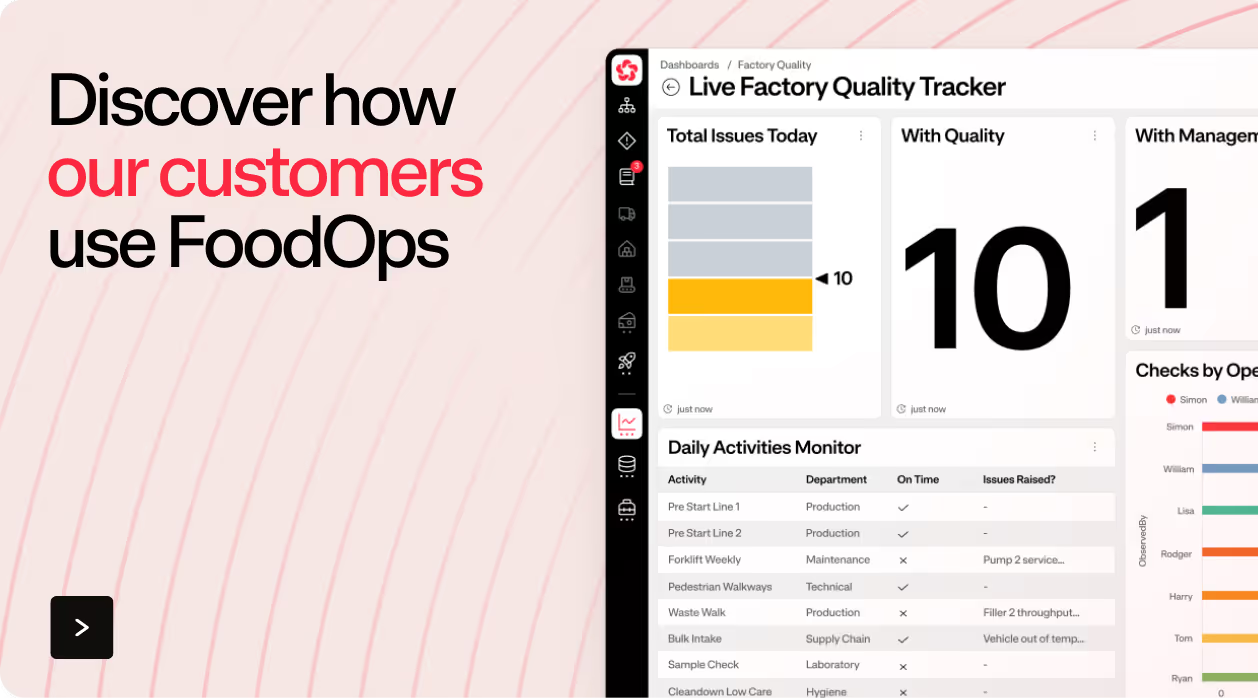
View your data in real-time, exactly how your teams want it.
Flexible factory applications, built around your operations.
FoodOps works seamlessly as part of your business.

Streamline non-conformance handling with custom workflows.

Automate your schedules and enjoy a live view of your operations.

Centralise your documentation and make it available effortlessly.
Unify teams from lairage to coldstore with connected digital workflows

Strengthen traceability, grading accuracy, and factory productivity with connected systems

Maximise yield, welfare compliance, and throughput with smarter workflows

Enhance efficiency and visibility across the entire operation, from field to packhouse

Transform your dairy operation with digital workflows and connected data

Empower teams with real-time data and digital workflows built to your exact SOPs
Build compliance into your processes by default and monitor with ease.

Empower your teams to make data-driven decisions.
Manage PPE, asset logs and follow-up actions all in one tool.
Get real insight into your supplier performance, in real time.
Set up and manage your hygiene processes all from one tool.
Streamline HSE with digital workflows for near misses and accidents.
Best Traceability Software for Food Manufacturers in 2026: A Practical Buying Guide

.png)
Food manufacturers across the UK have long faced a difficult decision: how to meet their traceability requirements while keeping processes practical, efficient and audit ready.
Whether you're starting from paper-based processes or considering a move away from your existing software platform, choosing the right traceability system can have a significant impact on your day-to-day operations.
The right system can give your team instant visibility from raw material intake through to finished product and despatch. It can reduce paperwork, strengthen audit readiness, improve recall response times and give production teams better access to the information they need.
With so many food manufacturing software platforms available, the challenge isn't finding a system that claims to offer traceability. It's finding one that actually works for your factory.
This guide explains what to look for when evaluating traceability software in 2026, the questions worth asking suppliers, and the red flags to watch for before you commit.
Quick Buying Guide: Food Traceability Software
Traceability software allows manufacturers to track ingredients, materials, batches and finished products throughout the production process.
A good system should give you a clear chain of information, from where ingredients came from, through production and processing, to where finished products were sent.
For UK food manufacturers, traceability also plays an important role in food safety, quality management and audit preparation to meet SALSA, BRCGS, and retailer-specific audit requirements.
At its simplest, that means being able to answer questions such as:
- Which supplier supplied this raw material
- Which lot or batch did it come from, what were their conditions on receipt
- Which production runs used it
- Which finished products contain it
- Where were those products dispatched
- What checks and records were completed during production
The value comes from connecting this information together rather than keeping it across spreadsheets, paper records and disconnected systems.
Eight Things to Look for When Choosing Food Traceability Software
Not all traceability systems are built for the realities of a working food factory. When comparing platforms, these are the areas we recommend questioning and testing.
1. How Does It Work on the Factory Floor?
This should be one of your first questions. A system can look excellent during a demo and still be difficult for production teams to use.
Think about the environment your operators actually work in. They may be moving between production areas, working around machinery and dealing with busy production schedules. The software needs to work with those conditions.
What to look for
Ask to see a typical production task, such as an intake process rather than simply showing you a dashboard, or better yet a procedure within your operation.
Can an operator:
- Start and complete a batch?
- Record a production check?
- Scan a barcode?
- Record a quantity or weight?
- Complete a sign-off?
- Correct an error?
- Easily view a specification?
The fewer steps involved, the more likely the system is to be adopted consistently.
The question to ask:
"Can our operators use this quickly and confidently during a busy production run?"
2. Can You Trace a Batch Both Ways?
Complete forwards and backwards traceability is a requirement for quality, food safety and audits, such as BRCGS.
What to look for
Pick a real process during the demo - the more complex and close to reality, the better.
Ask the supplier to show you:
Finished product → production batch → ingredients → supplier lots
Then reverse it:
Ingredient lot → production batches → finished products → despatches
Don't forget how things like secondary and waste products are handled, especially when they are used in further processing.
Ideally, this should take seconds rather than requiring someone to search through multiple systems.
The question to ask:
"How long does it take to trace a batch both ways, and does this happen automatically?"
3. Does it handle Mass Balance Automatically?
Similar to traceability, being able to mass balance a lot from a supplier all the way through the factory is critical for demonstrating process integrity.
What to look for
Again, pick a real process during the demo, the more complex and close to reality, the better. Ask the supplier to show you how to generate a mass balance at each process stage.
This is especially important for manufacturing processes that may be multi-stage, or combine outputs from previous stages, whilst factoring in process loss and yield.
This should also only take seconds to complete.
The question to ask:
"How long does it take to calculate a forwards mass balance and does this happen automatically?"
4. Does It Create Audit Evidence Automatically?
Food manufacturers need to demonstrate that processes were followed and checks were completed. This can include production records, quality checks, HACCP records, corrective actions, supplier information and other documentation required by your quality systems.
If your team still has to spend hours pulling information together before an audit, you may not be getting the full benefit of going digital.
What to look for
Ask the supplier:
- What records are captured automatically?
- Can we search historical records easily?
- Is there a complete audit trail?
- How can we link checks together to build an audit pack?
- Can reports be automatically generated?
- How quickly can we produce evidence for an auditor or customer?
The outcome is to make audit prep a by-product of your production rather than a last minute admin exercise.
The question to ask:
"How quickly can we access the evidence we need for an audit or customer request?"
5. Will It Fit the Way Your Factory Actually Works?
This is where many software projects go wrong. Food manufacturers have different products, processes, recipes, production lines, quality checks and operating procedures.
Your software shouldn't force you to completely redesign your operation simply to accommodate the platform. Look for a platform with flexible configuration rather than unnecessary customisation.
What to look for
During the demo, ask the supplier to replicate a process within your operation. Can a process be digitised easily, and can this be done internally? Then ask them to demonstrate how easy it would be to adjust the process (for example, adding an additional button to an intake screen to show additional supplier data).
The question to ask:
"How much of our process can we configure ourselves without expensive development work?"
6. Does It Integrate With Your Existing Systems?
Traceability shouldn't create another isolated database.
Your factory may already use an ERP, stock management system, accounting platform, weighing equipment or other operational software. Your traceability platform should fit into that technology landscape.
What to look for
Ask about:
- ERP integration
- Stock and inventory data
- Product and ingredient information
- Workflow integration
- Barcode and label systems
- Weighing equipment
- APIs
- Data exports
- Existing hardware
You should also understand exactly what integration involves:
- Is it included?
- Does it require additional development?
- Who maintains it?
- What happens when your existing system changes?
- Can this system manage other areas too?
These questions can prevent unexpected costs and change projects later.
The question to ask:
"How will this integrate this with the systems we already use?"
7. Is It Scalable?
Your requirements today won't be your requirements in three years.
You'll need to add:
- Production lines
- Products
- Users
- Sites
- Customers
- Quality processes
- Stock management
- New integrations
Your software should be capable of growing with you.
But scalability isn't just about handling more users. It's also about being able to add functionality without replacing the entire system.
What to look for
Think beyond your immediate traceability requirements. Consider what other areas of your factory you may want to digitise as your operation develops.
The question to ask:
"If we start with traceability today, what happens when we want to digitise other factory processes?"
The best platforms can expand as your operation develops rather than locking you into a single use case.
8. What Will Implementation Actually Look Like?
Implementation can be overlooked during the buying process.
A system may have all the features you need, but if it takes months to implement or requires a major operational overhaul, the project can become much more difficult than expected.
Before signing, ask for a clear implementation plan.
What to look for
You should understand:
- How long setup is expected to take
- What information you need to provide
- Who configures the system
- What training is included
- How users are onboarded
- What support is available after launch
- Whether you can start with one area before expanding
A good supplier should be able to explain this clearly as standard.
The question to ask:
"What will implementation look like for our factory, and what will we need to provide?"
Red Flags to Watch For
When evaluating traceability software, pay attention to what the supplier doesn't show you as much as what they do.
A one-size-fits-all demo
If the demo doesn't reflect how you'd actually use the software, ask to see your own processes and capabilities.
Features without workflow
A long feature list doesn't mean the software is easy to use. Ask the supplier to demonstrate the processes your team performs every day.
Expensive customisation
Be cautious if simple changes require development work or supplier involvement. Look for software you can configure as your operation evolves.
Poor integration
A connected factory floor offers the most value, and your systems need to work together. Make sure your traceability software can integrate with your existing technology rather than creating another silo.
Unclear implementation timelines
Cloud-based platforms can often be operational in weeks. If a supplier can't give you a clear timeline, or talks in terms of months without explanation, ask why.
Not designed for operators
If the people using the system find it difficult, adoption will suffer. Make sure the software is simple and practical for your shop-floor team.
No offline mode
Traceability doesn't only happen on the factory floor. Your team may need to capture information on a farm, at a port, during goods-in or at another offsite location where connectivity isn't guaranteed.
Check whether the software can work offline and sync data automatically when a connection is restored.
No food manufacturing knowledge
Food manufacturing has unique requirements around ingredients, allergens, batches, recipes, mass balance, yields, quality and audits. Make sure the supplier understands the realities of working in a food factory.
Food Traceability Software Buying Checklist
Rather than comparing suppliers based on feature lists alone, create a shortlist using the things that actually matter to your operation.
Consider areas such as:
Ask every shortlisted supplier to demonstrate the same scenario.
For example, if you're working in meat processing:
"Show us how you would receive a pallet of primals, record lot data and carry out intake checks, issue into butchery, book the finished batches, use the residual trim mixed with other batches to produce mince, and then validate the mass balance of the initial pallet."
A demo tailored to your production will tell you far more than a feature comparison sheet.
How FoodOps compares?
FoodOps is the factory operations platform for the food industry, offering complete traceability designed for the realities of food production.
FoodOps - The factory operations platform for the food industry
With FoodOps, manufacturers can:
- Digitise paper-based production and quality procedures
- Build factory applications tailored to their processes
- Track ingredients and batches through production
- Maintain traceability from intake through to despatch
- Retrieve audit evidence in minutes
- Respond to recall in seconds
- Capture information in real time
- Connect workflows across departments
- Improve visibility across factory operations
- Standardise processes across teams and sites
- Access operational data when decisions need to be made
Most importantly, the platform is designed around the factory, not the other way around.
Ready to See FoodOps in Action?
If you're evaluating traceability software for your food manufacturing operation, we'd be happy to show you how FoodOps works in a real factory environment.
We can explore your existing processes and show you how they could be digitised and connected through the FoodOps platform.
Book a demo and see what connected traceability software looks like>
.png)
.png)

Start your digital transformation today
Join the many businesses driving efficiency and compliance with FoodOps. Arrange a demo today to experience the future of food manufacturing.
