
Replace traditional paper forms with digital workflows.
View your data in real-time, exactly how your teams want it.
Flexible factory applications, built around your operations.
FoodOps works seamlessly as part of your business.

Streamline non-conformance handling with custom workflows.

Automate your schedules and enjoy a live view of your operations.

Centralise your documentation and make it available effortlessly.
Unify teams from lairage to coldstore with connected digital workflows

Strengthen traceability, grading accuracy, and factory productivity with connected systems

Maximise yield, welfare compliance, and throughput with smarter workflows

Enhance efficiency and visibility across the entire operation, from field to packhouse

Transform your dairy operation with digital workflows and connected data

Empower teams with real-time data and digital workflows built to your exact SOPs

Build compliance into your processes by default and monitor with ease.

Empower your teams to make data-driven decisions.
Manage PPE, asset logs and follow-up actions all in one tool.
Get real insight into your supplier performance, in real time.

Set up and manage your hygiene processes all from one tool.
Streamline HSE with digital workflows for near misses and accidents.
Is Your ERP System Falling Short of Your Quality Goals?

.png)
Enterprise Resource Planning (ERP) systems are a staple in food manufacturing, helping teams manage production, sales, inventory, procurement, and finance. Many ERPs also come with a quality module meant to support inspections, compliance, and reporting. However, this is often where ERP systems fall short.
We’ve spoken with food manufacturers nationwide who report quality challenges like fragmented data, manual processes, slow investigations, and limited visibility across the system.
The result: Quality is reactive, processes are fragmented and teams are forced to work around the system to fill the gaps.
Sound familiar? In this article, we break down what quality teams actually need from their systems, and why generic ERP modules aren’t cutting it.
What Does a Generic ERP Actually Provide for Quality Teams?
Most ERP systems offer basic quality modules, but their capabilities are often limited.
Typical functionality includes:
- Basic workflows: Generic ERPs can route forms and approvals, but they don’t support complex processes or integrate with other tools easily.
- Validation features: Some manual checks can be digitised, but validation often still requires human intervention.
- Paperless forms: ERPs reduce paperwork, but without automated task management, the underlying processes remain manual.
- Data tracking: Standard modules can store quality data, but often in a format that's fragmented and relies on workarounds.
We've found that most ERP quality modules act as limited digital form builders rather than intelligent process automation tools. Because ERPs are often designed to support multiple manufacturing sectors, their quality functionality can lack the industry-specific logic required to truly digitalise quality on the factory floor, such as enforcing food safety controls, managing exceptions in real time, and maintaining audit-ready traceability.
For example, during a traceability exercise or recall, an ERP may be able to show which batches were used in production, but it often can't dynamically link all related events, such as rework or intermediate processing steps, without manual intervention. This can make it difficult to generate a complete, accurate trace in real time.
Beyond Forms: Why Automation Matters
A quality management platform should do more than replace paper—it should automate, schedule, and solve tasks on the factory floor.
Ask yourself if your current system can:
- Automate workflows: Route inspection results, non-conformance alerts, and corrective action follow-ups automatically to the right people
- Contextualise data: Link quality events with production, suppliers, and compliance to deliver actionable insights across the operation
- Schedule and track tasks: Keep deadlines on track and ensure nothing falls through the cracks—without relying on emails, spreadsheets, or to-do lists
- Maintain traceability: Track every product batch, supplier input, and inspection outcome in a fully auditable chain, supporting food safety and regulatory compliance
Example in Practice: Line Inspection
Imagine a line inspection. With a generic ERP platform, your team fills out the form, then manually emails the results, tracks corrective actions in spreadsheets, and updates multiple logs.
With a workflow automation platform (like FoodOps), the inspection:
- Automatically notifies relevant personnel of results
- Triggers follow-up tasks for non-conformance
- Updates logs and integrates with production metrics in real time
- Maintains complete traceability from raw materials to finished product
This approach goes beyond simple form digitisation, enabling consistent process automation for inspections, corrective actions, and follow-ups. With modern no-code tools, process changes and revisions can be rolled out in hours, not weeks.
Spot the Signs Your ERP Isn’t Enough
ERP quality modules can be useful, but there are some clear signs when they may not be fully supporting day-to-day quality operations:
- Relying on spreadsheets and emails to manage tasks
- Entering duplicate data across multiple systems
- Experiencing delays in tracking corrective and preventive actions
- Having limited visibility into compliance status and performance trends
- Needing manual workarounds to bridge gaps in the system
- Lacking end-to-end traceability, making it difficult to track products, ingredients, or inspections across the supply chain
If these challenges sound familiar, it may indicate that your ERP is not fully supporting the needs of your quality processes.
Moving to Intelligent Process Automation
To effectively support modern quality operations, systems need to go beyond simple form digitisation. A modern quality platform should:
- Automate repetitive tasks instead of relying on manual processes
- Validate data automatically to reduce errors and inconsistencies
- Support scheduling tasks and tracking deadlines
- Integrate quality insights with operational metrics
- Provide end-to-end traceability for products, ingredients, and inspections
FoodOps addresses these challenges with a platform built specifically for the factory floor. It includes a powerful quality management capability while also connecting wider factory operations. By automating workflows, centralising data, and enhancing visibility, FoodOps transforms quality from time-consuming workarounds into a proactive, structured operation.
It also integrates seamlessly with existing ERP systems, allowing both platforms to work together as part of a unified factory operation.
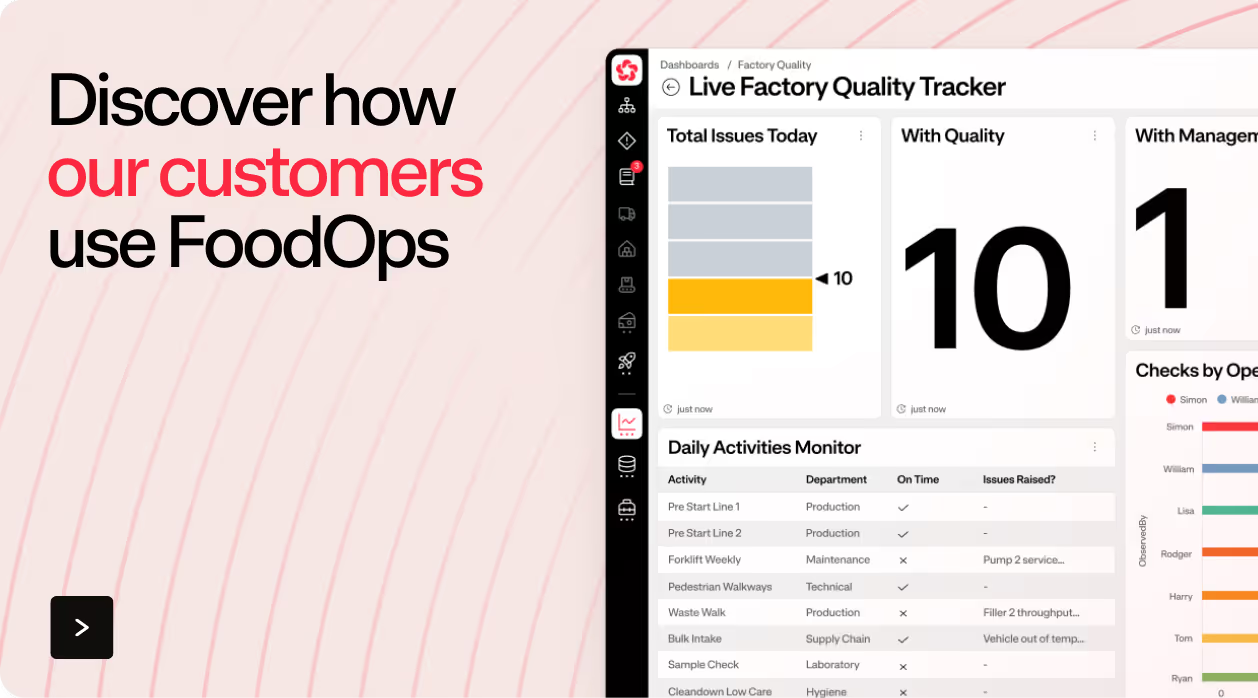
QA and technical teams gain instant access to completed checks and real-time dashboards custom-built for your operations. This visibility frees up time to focus on proactive quality management rather than chasing data. The result is not only improved quality, but also greater speed and simplicity in day-to-day operations.
FoodOps’ intuitive, user-friendly platform allows teams to:
- Update and roll out process changes in hours, not weeks
- Digitise inspections and complete them in real time across the production line, cold storage, or on the farm
- Maintain end-to-end traceability across ingredients, batches, and inspections
- Automate workflows, tasks, and corrective actions across the factory floor
- Access procedures, documents, and schedules directly within operational workflows
- Stay audit-ready with accurate records and minimal administrative effort
- Continue working offline with full multi-device compatibility
By embedding process automation into quality management, FoodOps enables teams to act quickly, prevent issues before they escalate, and maintain full traceability and compliance at every step.
If you’re exploring ways to modernise quality management while keeping your ERP in place, it may be worth seeing how FoodOps fits into your factory environment.
.png)
.png)
Start your digital transformation today
Join the many businesses driving efficiency and compliance with FoodOps. Arrange a demo today to experience the future of food manufacturing.
