
Replace traditional paper forms with digital workflows.

View your data in real-time, exactly how your teams want it.
Flexible factory applications, built around your operations.
FoodOps works seamlessly as part of your business.

Streamline non-conformance handling with custom workflows.

Automate your schedules and enjoy a live view of your operations.

Centralise your documentation and make it available effortlessly.
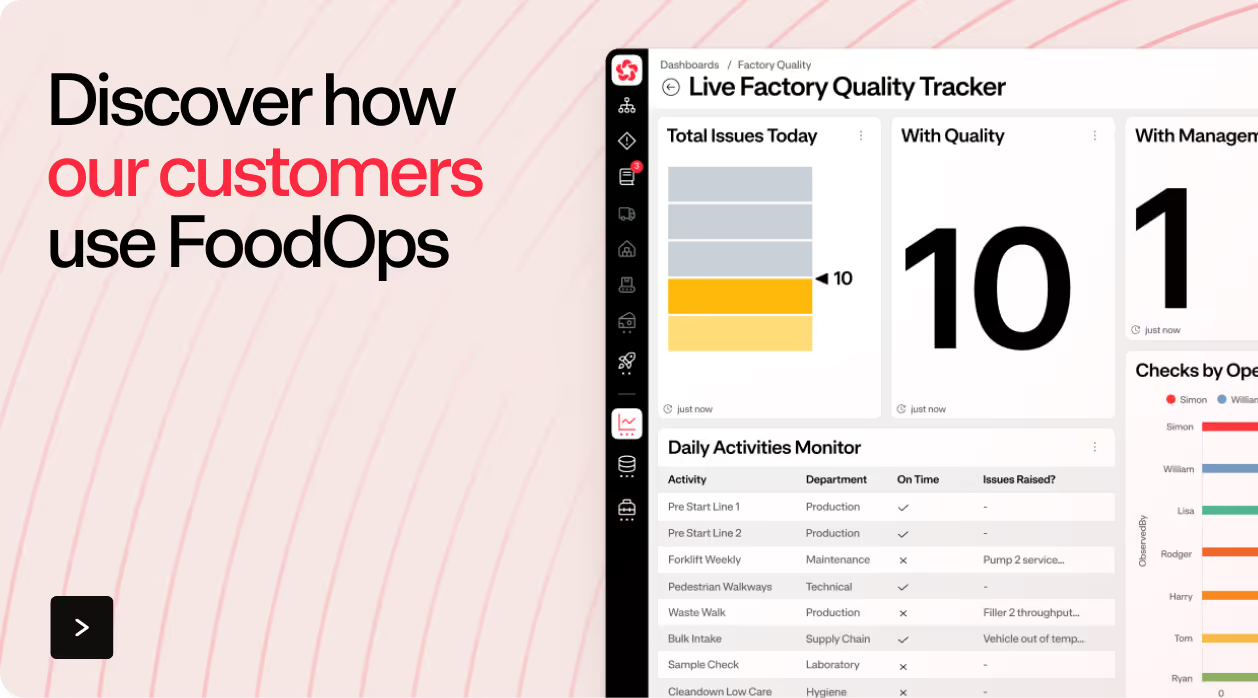

Unify teams from lairage to coldstore with connected digital workflows

Strengthen traceability, grading accuracy, and factory productivity with connected systems

Maximise yield, welfare compliance, and throughput with smarter workflows

Enhance efficiency and visibility across the entire operation, from field to packhouse

Transform your dairy operation with digital workflows and connected data

Empower teams with real-time data and digital workflows built to your exact SOPs

Build compliance into your processes by default and monitor with ease.

Empower your teams to make data-driven decisions.
Manage PPE, asset logs and follow-up actions all in one tool.
Get real insight into your supplier performance, in real time.

Set up and manage your hygiene processes all from one tool.

Streamline HSE with digital workflows for near misses and accidents.
8 Ways Digital Workflows Simplify BRCGS Compliance

.png)
BRCGS is a globally recognised food safety standard that helps manufacturers ensure safe, consistent, high-quality production. While digitisation isn’t required for certification, BRC audits are becoming more data-driven, increasing expectations around the speed, accuracy, and traceability of records.
Manual systems can make it difficult to retrieve documents quickly and maintain reliable audit trails under pressure. As a result, many manufacturers are adopting digital tools to centralise documentation, improve traceability, automate corrective actions, and support continuous improvement.
In this blog, we explore how digital tools help streamline BRC compliance, reduce audit pressure, and improve the efficiency of quality management processes.
1) Always Audit Ready
One of the biggest shifts is moving from audit preparation to continuous readiness. Instead of spending hours gathering paperwork in the weeks leading up to an audit, information is recorded and stored as part of normal operations.
With centralised systems, records can be retrieved in minutes rather than hours. This reduces pressure on QA teams and allows more focus on maintaining standards rather than chasing documentation in preparation for the next audit.
2) Improved Document Control
Document control remains a core requirement within the BRC audit, covering procedures, HACCP plans, supplier approvals, training records and more.
Digital systems improve control by ensuring:
- Only the latest approved versions are accessible
- Obsolete documents are automatically retired
- Access is consistent across departments
- Records are securely stored and traceable
Digital document control reduces the risk of teams working from outdated instructions and improves consistency across site operations.
3) Enhanced Traceability
Traceability is one of the most heavily scrutinised areas in a BRC audit. Manufacturers must demonstrate clear links from raw materials through to finished goods and be able to execute mock recalls effectively.
Digitised traceability systems strengthen this by:
- Tracking batches in real time
- Reducing manual data entry errors
- Improving stock visibility
- Connecting suppliers, production, and despatch data
- Supporting faster recalls
- Automating full forward-backwards traceability
- Adding digital traceability tags to products
In the event of a recall, the ability to quickly isolate and trace affected products significantly reduces both operational and reputational risk.
4) Real-time Monitoring and Alerts
Manual checks can introduce delays or inconsistencies, especially in fast-paced production environments.
Digital monitoring allow critical controls, such as temperature checks, CCP monitoring, cleaning verification, and equipment calibration schedules to be recorded in real time. When limits are exceeded or checks are missed, alerts can be triggered immediately so corrective action can be taken without delay.
This shift from reactive to proactive control is increasingly reflected in audit expectations.
5) Stronger Internal Audits and Corrective Actions
Internal audits are most effective when they identify and resolve issues before the external assessment.
Digital platforms, just like FoodOps, support this by enabling:
- Mobile audit completion on the factory floor
- Standardised checklists across multiple sites
- Real-time logging of non-conformances
- Automated task assignment for corrective actions to assigned users
- Clear tracking of close-out status
This improves visibility of accountability, speeds up the process and ensures corrective actions are not lost in email chains or spreadsheets.
6) Better Data Analysis and Reporting
Digitisation allows trends to be identified that would be difficult to spot manually.
When data is centralised, teams can analyse:
- Non-conformances
- Foreign body incidents
- Supplier performance
- Downtime patterns
- Audit findings over time
Accurate, real-time data enables more informed decision-making and helps demonstrate continuous improvement during audits, rather than relying on isolated incident reports.
7) Improved Training Management
Training is a key part of demonstrating competence under BRCGS, particularly for roles affecting food safety and quality.
Digital systems help ensure training is consistently managed with:
- Competency records
- Refresher schedules
- Induction completion
- Employee sign-offs
- Training documents embedded within procedures
This makes it easier to evidence that staff are trained appropriately for their responsibilities at any point.
8) Supporting Food Safety Culture
Auditors are increasingly looking beyond documentation to understand how food safety culture is embedded across an organisation.
Digital systems support this by improving:
- Transparency of actions and issues
- Accountability for corrective actions
- Management visibility of site performance
When information flows in real time, it becomes easier for teams to respond quickly and consistently, reinforcing a more proactive approach to food safety.
The Value of Digitising BRCGS Compliance
Digitisation isn’t just about reducing paper. It’s about creating a more efficient, resilient, and compliant operation that is always audit ready.
Businesses that invest in digital systems often experience:
- Reduced audit prep time
- Fewer non-conformities
- Faster corrective action closure
- Greater operational visibility
- Improved confidence during audits
FoodOps: The Connected Factory Platform Built for Food Manufacturers
FoodOps is the connected factory platform built specifically for the food industry, and is used by BRC-accredited manufacturers nationwide to manage quality, production, stock and more across the factory floor.
FoodOps allows teams to:
- Automate inspections, audits, and non-conformances
- Maintain real-time traceability from intake to despatch
- Speed up claims and investigations with a complete digital audit trail
- Schedule critical tasks based on users, such as allergen control and quality actions
- Optimise the factory floor with connected data and transparent operation
- Digitise exact workflows for quality, production, stock, document control and more with our no-code app studio
.png)
.png)
.png)
Start your digital transformation today
Join the many businesses driving efficiency and compliance with FoodOps. Arrange a demo today to experience the future of food manufacturing.
