
Replace traditional paper forms with digital workflows.
View your data in real-time, exactly how your teams want it.
Flexible factory applications, built around your operations.
FoodOps works seamlessly as part of your business.

Streamline non-conformance handling with custom workflows.

Automate your schedules and enjoy a live view of your operations.

Centralise your documentation and make it available effortlessly.
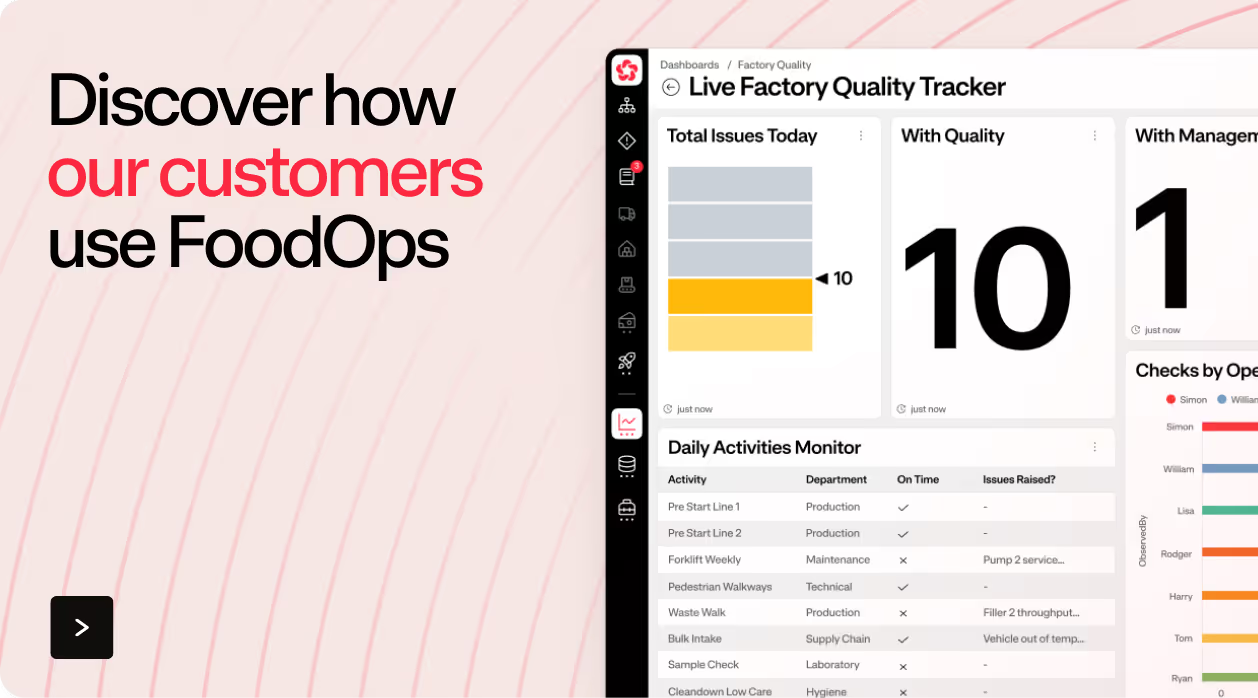
Unify teams from lairage to coldstore with connected digital workflows

Strengthen traceability, grading accuracy, and factory productivity with connected systems

Maximise yield, welfare compliance, and throughput with smarter workflows

Enhance efficiency and visibility across the entire operation, from field to packhouse

Transform your dairy operation with digital workflows and connected data

Empower teams with real-time data and digital workflows built to your exact SOPs

Build compliance into your processes by default and monitor with ease.

Empower your teams to make data-driven decisions.
Manage PPE, asset logs and follow-up actions all in one tool.
Get real insight into your supplier performance, in real time.

Set up and manage your hygiene processes all from one tool.
Streamline HSE with digital workflows for near misses and accidents.
Food Manufacturing Software: 11 Key Features Every Factory Floor Needs

.png)
Food manufacturers today face tighter margins, stricter compliance, and constant pressure to improve factory floor efficiency, yet many still rely on paper workflows or legacy production systems.
This is where food manufacturing software can make a real difference. Designed specifically for the factory floor, it helps teams manage operations, quality, traceability and more in real time.
In this guide, we explore 11 must-have features of food manufacturing software to optimise factory floor performance and deliver measurable ROI.
What Is Food Manufacturing Software? (Factory Floor vs ERP)
Food manufacturing software for the factory floor is different from traditional ERP systems.
While ERP systems focus on planning, finance, and supply chain management, factory floor software handles execution and real-time production control.
These platforms include:
- Factory floor software
- Production management systems
- Manufacturing Execution Systems (MES) for food
- Shop floor control tools
- Quality Management platforms for food
These tools connect with ERP systems to automate factory floor procedures, providing real-time insights and actionable data for operators, managers and quality teams.
11 Must-Have Features of Food Manufacturing Software
1. Real-Time Production Visibility
We've placed this at number one because real-time visibility across the factory floor offers many benefits.
The right platform should provide:
- Live dashboards to monitor output as it happens
- Bottleneck and downtime alerts to catch issues before they escalate
- Data-driven insights for operational decisions
- Instant visibility into every stage of production
Without real-time dashboards and customisable reports, manufacturers are always working a step behind. How often have you spent hours gathering data just to view an outdated insight?
With live production visibility, decisions become faster, more accurate, and directly tied to actual performance on the floor.
2. End-to-End Batch & Lot Traceability
We all know how important traceability is, and automated systems make it much easier for operators and quality teams to act quickly. How fast could your team respond to a recall with your current tools?
The right platform should provide:
- Rapid recall management if issues arise
- Complete batch tracking from raw materials to finished goods
- Digital traceability records for every step of production
Full batch and lot tracking gives quality teams the tools to identify problems instantly, respond fast, and maintain compliance, safeguarding both customers and your reputation.
3. Automated Quality Management
Keeping quality front of mind, how much time do your quality teams spend chasing records, reacting to issues, or entering data manually?
The right platform embeds quality directly into production, including:
- Digitised quality workflows for real-time operation updates
- Automated alerts for deviations or out-of-spec products
- Task management to assign and track quality-related actions
- Custom quality reports tailored to your processes
These tools let quality teams work proactively, giving them time to track trends, identify risks early, and resolve issues quickly.
4. Build & Automate Complex SOPs for Food Manufacturing
Production processes shouldn't be amended for your software, the right platform lets teams digitise even the most detailed SOPs.
Look for:
- No-code procedure builders so anyone can create or modify processes easily
- Automated, validated workflows on the factory floor to ensure consistency
- Task tracking and reminders to make sure every step is completed correctly
With these tools, production teams can adapt quickly to changes, maintain compliance, and execute processes accurately, no matter how complex the workflow.
5. Integration with Other Systems
Data silos are a common issue in food manufacturing, and disconnected production slows down decisions and increases errors.
Look for a food manufacturing platform that integrates seamlessly with:
- ERP systems for planning, finance, and inventory
- Equipment and IoT devices for live production data
- Internal and external data sources
By connecting systems, manufacturers can create a single source of truth, streamline workflows, and make faster, data-driven decisions across the factory floor.
6. Smart Document Control
Managing SOPs, HACCP plans, and compliance documents can quickly become overwhelming.
Who’s read what, and is everyone working from the most up-to-date version?
The right platform offers digital document management, including:
- Centralised storage for all production and quality documents
- Version control so teams always use the latest approved procedures
- Easy access for audits, training, and daily operations
- Linked documents that connect SOPs and training materials directly to relevant procedures on the shop floor
With these tools, everyone works from up-to-date documentation, reducing errors, supporting compliance, and keeping operations running smoothly.
7. Scalable Production Management
Picture this: you’ve just won a new contract and need to increase production by 30%. Can your current system handle that without added risk or extra labour?
The right platform provides scalable solutions, including:
- Multi-site management to oversee different factories or locations from a single system
- Flexible, easy-to-build workflows to handle new products, processes, or procedures as operations grow
With a flexible factory floor platform, food manufacturers can scale operations confidently, maintain efficiency, and ensure compliance across all locations and teams, without overhauling existing systems.
8. Usable for All Teams
You may spend hours finding the right software, but it's only effective if teams actually use it. Clunky workarounds and slow updates are often why teams avoid using software.
The right platform is designed for all roles, on the floor and in the office. Look for:
- Intuitive interfaces that operators, supervisors, and managers can use with ease
- Role-specific dashboards and access controls to provide the right data to the right people
- Minimal training requirements for fast adoption and immediate impact
With high usability, every team member can use the platform, boosting efficiency, reducing errors, and maximising ROI across your operations.
9. Accessible Anywhere
Food manufacturing happens across multiple locations: the farm, the port, the cold room, and the factory floor, so teams need access wherever they are.
The right platform provides:
- Multi-device access so all departments can use the platform, whether on the shop floor or in the quality office
- Remote monitoring for managers and executives to stay informed anywhere
- Secure cloud access that keeps data safe without slowing operations
- Offline mode so teams can update actions and complete inspections digitally wherever they are
With these capabilities, web-based platforms help operations run faster, reduce downtime, and keep production moving.
10. Automate Operation-Critical Tasks
Manual processes are slow, repetitive, and prone to errors. The right platform automates critical production tasks, such as:
- Automating repetitive tasks to save time and reduce mistakes
- Alerts for deviations or downtime so issues are flagged instantly
- Real time production data updates without manual entry
By automating operation-critical tasks, food manufacturers can reduce errors, free up teams for higher-value work, and keep production running efficiently.
11. Maintain Audit Readiness
Last but by no means least, regulatory compliance and audits are a constant part of food manufacturing, and they can be very time-consuming. How long did you spend preparing for your last BRC audit?
The right platform keeps your factory audit-ready at all times, with:
- Real-time custom compliance tracking so teams stay informed
- Complete digital audit trails that record every action and change
- Easy reporting for HACCP, BRC, ISO, and other standards
With these tools, you can pass audits with confidence, reduce risk, and foster a culture of accountability across the factory floor and office teams.
Choosing the Right Platform for Your Operation
Choosing the right food manufacturing software is about enabling better performance across the factory floor.
The best platforms provide real-time visibility, digital validated workflows, traceability, flexible process control, and seamless integrations, while supporting all teams and keeping operations scalable, automated, and audit-ready.
If you're looking for a platform that provides all this and more, we’d like to introduce FoodOps, the connected factory platform for the food industry.
About FoodOps
FoodOps is the connected factory platform built specifically for food manufacturers, helping operations replace paper-based processes with connected digital workflows.
With FoodOps, manufacturers can:
- Digitise workflows for quality, production, stock, document control and more with our no-code app studio
- Improve real-time visibility across factory operations
- Reduce paperwork and manual admin
- Maintain traceability from intake to despatch
- Standardise processes across lines, teams, and sites
- Respond faster to operational issues with connected real-time data
No replacing workflows. No unnecessary disruption. Just a connected system that improves operational efficiency, compliance and visibility from day one.
.png)
.png)
.png)
Start your digital transformation today
Join the many businesses driving efficiency and compliance with FoodOps. Arrange a demo today to experience the future of food manufacturing.
