
Replace traditional paper forms with digital workflows.

View your data in real-time, exactly how your teams want it.

Flexible factory applications, built around your operations.

FoodOps works seamlessly as part of your business.

Streamline non-conformance handling with custom workflows.

Automate your schedules and enjoy a live view of your operations.

Centralise your documentation and make it available effortlessly.

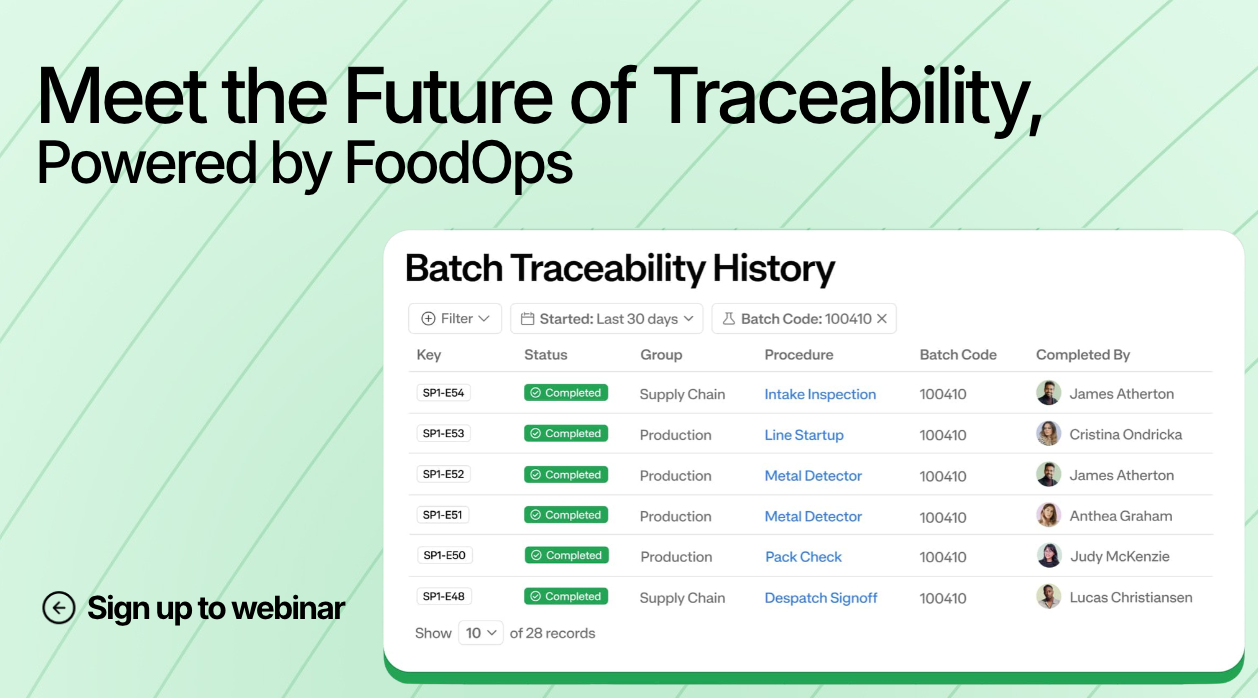
Automate traceability & mass balance from stock to despatch.

Unify teams from lairage to coldstore with connected digital workflows

Strengthen traceability, grading accuracy, and factory productivity with connected systems

Maximise yield, welfare compliance, and throughput with smarter workflows

Enhance efficiency and visibility across the entire operation, from field to packhouse

Transform your dairy operation with digital workflows and connected data

Empower teams with real-time data and digital workflows built to your exact SOPs

Build compliance into your processes by default and monitor with ease.

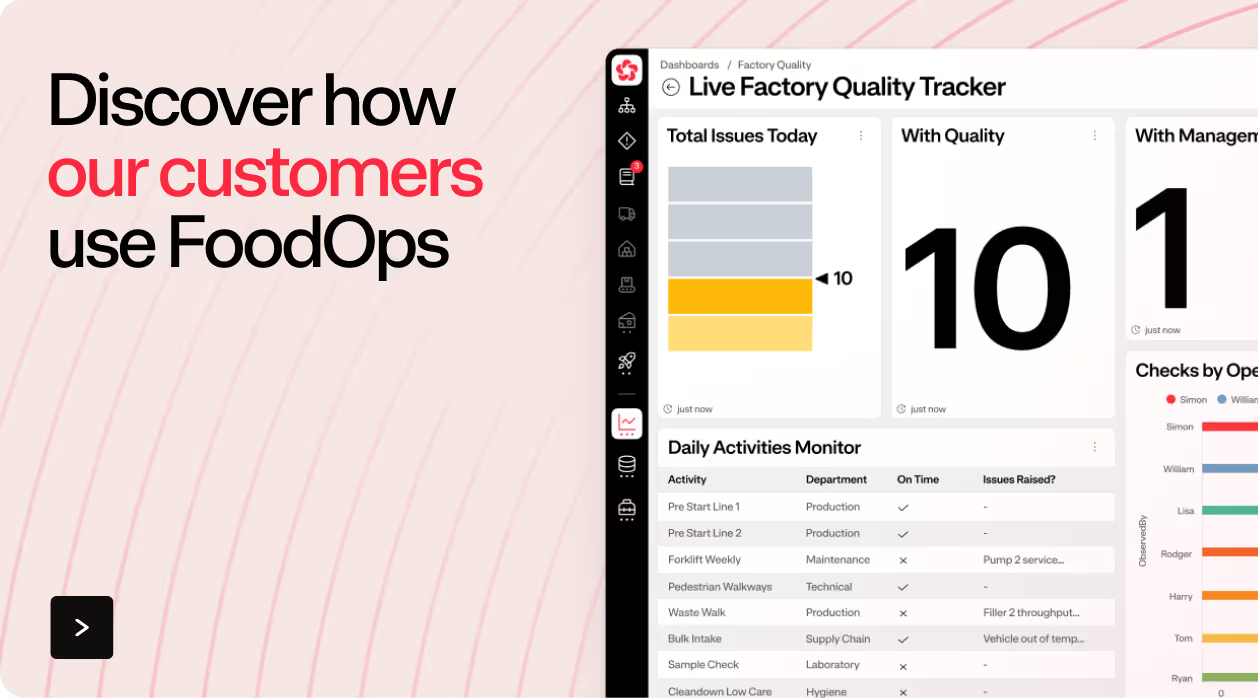
Empower your teams to make data-driven decisions.
Manage PPE, asset logs and follow-up actions all in one tool.

Get real insight into your supplier performance, in real time.

Set up and manage your hygiene processes all from one tool.

Streamline HSE with digital workflows for near misses and accidents.
Food Production Software Guide for 2026 | What Food Manufacturers Need


The food manufacturing industry is changing rapidly. Rising production costs, higher customer expectations and tighter food safety regulations mean manufacturers need to find better ways to manage their operations. Relying on spreadsheets, paperwork and outdated systems can make this difficult.
The right software can bring production, quality, stock management, traceability and factory teams together in one place. This gives businesses better control and helps them make informed decisions.
But with so many solutions available for food manufacturers, what features should be prioritised?
Whether you run a bakery, meat processing facility, dairy, fresh produce business or large-scale manufacturing operation, this guide explores 15 features to look for when choosing food production software in 2026.
1. Paperless Processes and Digital Workflows
Quality checks, temperature monitoring, cleaning schedules, production records and goods-in inspections all create a lot of outputs. Paper-based processes can lead to missing information, duplicated records and time wasted managing paperwork.
Food production software helps replace these manual processes with digital forms and workflows, making information easier to record, access and manage.
Look for software that allows you to:
- Convert existing paper forms into digital procedures.
- Create customised forms for quality, hygiene and production.
- Capture information directly from tablets, mobiles and computers.
- Set mandatory fields and validation rules to reduce errors.
- Automatically record dates, times and user activity.
- Store completed records in a searchable digital archive.
- Access procedures even in areas with limited connectivity.
Going paperless is about more than removing physical paperwork. It creates a consistent way of collecting operational information, improving accountability and making factory data accessible when it's needed.
2. Automation That Reduces Manual Work
Automation is one of the biggest opportunities for food manufacturers looking to improve productivity in 2026.
Many factory processes still depend on employees remembering to complete checks, send emails, update spreadsheets or notify managers when something goes wrong.
Food factory software should remove these repetitive tasks wherever possible.
For example, automation can be used to:
- Send reminders when scheduled checks are due.
- Notify managers when a critical limit is breached.
- Automatically raise non-conformances following failed inspections.
- Escalate overdue actions to the relevant team.
- Generate reports when production activities are completed.
- Trigger follow-up tasks based on specific events.
- Synchronise information between connected systems.
The biggest advantage is that automation helps teams move from reactive management to proactive operations. Instead of discovering problems during an audit or at the end of a shift, teams can receive immediate notifications and take action before issues escalate.
3. Flexible Factory Operations and Customisable Software
No two food factories operate in exactly the same way.
A bakery has very different production requirements from a meat processor, dairy manufacturer or fresh food business. Even two manufacturers producing similar products may have completely different processes, equipment and operational requirements.
This makes flexibility an important consideration when choosing food manufacturing software.
Rather than forcing businesses to change their processes to fit a rigid software package, modern platforms should adapt to the way individual factories operate.
Look for solutions offering:
- Customisable digital workflows.
- Configurable forms and procedures.
- Flexible production processes.
- Different permissions for different teams.
- Custom fields and data capture.
- The ability to add new processes as the business grows.
- No-code or low-code configuration options.
Flexible software also makes it easier to introduce operational improvements without lengthy development projects.
As your factory expands, introduces new products or changes production methods, your internal team should be able to evolve your digital processes alongside it.
4. Custom Dashboards and Real-Time Reporting
Factory managers need access to accurate information to understand how their operations are performing.
However, when data is spread across spreadsheets, paper records and separate software systems, getting a clear picture of factory performance can be difficult.
Custom dashboards and reporting tools bring important operational information together in one place.
The best food production software should allow users to create dashboards around their own business requirements and KPIs.
Examples include:
- Production output and performance.
- Quality inspection results.
- Non-conformance trends.
- Stock levels and ingredient availability.
- Waste and yield figures.
- Equipment performance.
- Hygiene and cleaning compliance.
- Production efficiency across shifts or sites.
Different teams should also be able to access dashboards relevant to their responsibilities.
For example, production managers may need to monitor output and downtime, while technical managers need visibility of quality checks, non-conformances and compliance.
Look for software with customisable charts, tables, performance indicators and automated reporting. Ideally, reports should also be scheduled or automatically generated when specific events occur.
5. A Centralised Document Centre
Document control is essential in food manufacturing, particularly for operations working towards standards such as BRCGS and maintaining HACCP systems. Manufacturers need to manage a wide range of documents, including SOPs, food safety policies, risk assessments, training materials, supplier specifications and quality records.
A centralised document centre brings everything together in one place, making documents easier to access, update and control.
Look for functionality such as:
- Built-in document creation and the ability to upload existing files.
- Version control to ensure employees always access the latest approved documents.
- Approvals and Permissions controls
- Anywhere access, allowing teams to find documents from the office or factory floor.
- The ability to link SOPs and training materials to relevant procedures for factory floor operators
- Document tracking and audit trails to support compliance and food safety audits.
A centralised document centre helps maintain accurate records, improve visibility and ensure employees always have access to the right information.
6. End-to-End Traceability and Mass Balance
Food manufacturers need to know where ingredients come from, how they move through production and where finished products are sent. Accurate traceability is essential for managing food safety incidents, product recalls and compliance.
Mass balance is equally important, helping manufacturers track the quantities of materials entering and leaving production, including waste, yield and finished goods.
Look for features such as:
- End-to-end traceability from raw material intake to despatch.
- Digital traceability tags.
- Real-time compliance visibility.
- Instant search and filtering across manufacturing processes.
- Automated mass balance calculations from stock to despatch.
- Live production yield monitoring.
Connecting stock, production, quality and despatch data makes traceability part of everyday operations, rather than a manual exercise when an audit or recall occurs.
7. Production Management and Planning
Without a connected production management system, teams may rely on spreadsheets, whiteboards and manual communication to organise production schedules and monitor progress.
This can create problems with ingredient availability, production planning, resource allocation and delivery deadlines.
Food production software should help manufacturers manage production from planning through to completion.
Important functionality includes:
- Production order management.
- Production scheduling.
- Batch and lot tracking.
- Ingredient allocation.
- Production progress monitoring.
- Actual versus planned production.
- Waste and yield recording.
- Production reporting.
- Shift and team visibility.
Ideally, production management should connect directly with stock control, quality management and traceability. This allows teams to understand whether the necessary ingredients are available, whether quality checks have been completed and whether production is progressing as expected.
The result is a more organised factory with fewer communication gaps and greater visibility.
8. Built-In Chat and Team Communication
Communication is critical in a busy food manufacturing environment. Production teams, quality managers, maintenance staff, warehouse employees and senior management all need to share information quickly.
When communication takes place across different messaging apps, emails, telephone calls and paper notes, important information can easily get lost.
Food production software should ideally include built-in communication functions that allow employees to collaborate within the same operational environment.
Useful chat and communication features include:
- Direct messaging between employees.
- Group conversations for departments or shifts.
- Notifications about important operational events.
- Communication linked to specific production orders or tasks.
- Updates on outstanding actions and non-conformances.
Keeping communication connected to operational data reduces confusion and helps teams work together more effectively.
9. Overall Equipment Effectiveness (OEE)
Equipment performance has a direct impact on manufacturing productivity.
Unexpected breakdowns, slow production speeds and frequent changeovers can all reduce output and increase operating costs.
Overall Equipment Effectiveness (OEE) is a key performance measure used to understand how effectively manufacturing equipment is being utilised.
OEE combines three important measurements:
- Availability: How much of the planned production time equipment is actually running.
- Performance: Whether equipment is operating at its intended production speed.
- Quality: The proportion of products manufactured correctly without defects.
Look for functionality that supports:
- Production downtime recording.
- Equipment performance monitoring.
- Planned versus actual output.
- Changeover tracking.
- Production speed monitoring.
- Defect and reject recording.
- OEE dashboards and trend analysis.
- Connecting machinery for accurate data records
Food production software should make it easier to capture and analyse the information needed to monitor these measurements.
10. Workflow Automation and Intelligent Triggers
While general automation reduces repetitive work, more advanced workflow automation allows different parts of the factory to respond automatically to operational events.
This is particularly valuable when processes involve multiple departments or approval stages.
For example, imagine a quality inspection identifies a temperature outside the acceptable range.
Instead of relying on an operator to notify a manager and manually raise an issue, the software could automatically:
- Record the failed inspection.
- Generate a non-conformance.
- Notify the relevant quality manager.
- Place the affected batch on hold, where integrated controls support this.
- Create a corrective action.
- Escalate the issue if it remains unresolved.
- Retain the complete audit trail.
These types of automated workflows help ensure that important actions are not forgotten.
When evaluating software, look for configurable triggers, conditional workflows, automatic notifications, escalation rules and integrations with other factory systems.
The objective is to build a factory where information moves automatically between processes, rather than relying on employees to manually transfer it.
11. Stock Management and Inventory Control
Effective stock management is essential for maintaining production schedules, controlling costs and reducing waste. Food manufacturers need visibility of ingredients, packaging, work-in-progress and finished goods, alongside batch numbers, expiry dates and stock movements.
Important stock management features include:
- Real-time stock visibility across locations, warehouses and production areas.
- Batch and lot tracking.
- Goods-in, goods-out and internal stock transfers.
- Expiry and shelf-life management.
- FIFO and FEFO stock rotation.
- Production material and ingredient consumption tracking.
- Stock reconciliation and mass balance.
- Customisable stock properties and data fields.
- Integration with production and purchasing.
- Live stock updates linked directly to production activities.
Better stock visibility can reduce over-ordering, prevent unnecessary waste and help ensure production has the ingredients it needs.
12. Bill of Materials (BOM) Management
For food manufacturers, accurate Bill of Materials (BOM) management is essential for controlling recipes, ingredient usage, production costs and stock requirements. Food manufacturers need to know exactly how much of each ingredient and packaging material is required for every production run.
Look for features such as:
- Product recipes and ingredient specifications.
- Defined ingredient quantities.
- Multiple product and recipe versions.
- Approved ingredient substitutions.
- Packaging material requirements.
- Production quantity calculations.
- Ingredient allocation against production orders.
- Integration with stock management.
- Actual versus expected ingredient usage.
Connecting BOM management with inventory and production helps manufacturers calculate material requirements accurately, monitor yields, identify ingredient variances and control production costs.
13. Hardware and Machine Connectivity
Many food manufacturers already use weighing scales, barcode scanners, label printers, temperature sensors and production machinery. However, when these devices operate independently, valuable information often needs to be transferred manually into other systems, which can lead to errors. Hardware connectivity helps bridge this gap, allowing equipment to communicate directly with food production software.
Look for features such as:
- Built-in third-party connectors to link production software with external business systems.
- Peripheral hardware connectivity for scales, label printers, document printers and barcode scanners.
- Protocol abstraction to communicate with devices through serial and other supported methods.
- Configuration-led device integration without requiring new application code for every installation.
- Centralised hardware management to configure, deploy and maintain connected devices.
- Rapid hardware replacement to minimise integration effort and production downtime.
Connecting hardware directly to software allows information to flow between equipment and operational systems, improving efficiency, accuracy and reducing reliance on manual processes.
14. Integration With Existing Business Systems
Food manufacturers often use several different software systems to manage their operations. These may include finance, purchasing, enterprise resource planning (ERP), warehouse management, quality management and production planning.
When these systems don't connect, information can become duplicated, administration increases and reporting becomes inconsistent. Food production software should make it easy to share information between different platforms.
Look for:
- ERP integrations.
- Accounting system connectivity.
- Warehouse management integrations.
- API access.
- Database connectivity.
- Third-party software integrations.
- Real-time data exchange.
- Hardware and machinery integration.
Connecting your systems reduces manual data entry and gives management teams a clearer view of the business, from incoming materials and production performance to finished goods and despatch.
15. Scalable Software That Grows With Your Business
Food production software should be a long-term investment rather than a solution that only meets today's requirements.
Your software needs to adapt as these changes happen, without becoming difficult or expensive to manage.
When evaluating a platform, consider:
- The ability to create new workflows internally.
- Support for additional departments and users.
- Multi-site functionality.
- Flexible reporting as business KPIs change.
- The ability to connect new equipment and third-party systems.
- Customisable processes without complex development.
- The ability to handle increasing amounts of operational data.
The right food production software should support your business as it grows, without requiring you to replace your systems as your needs change.
What Should Food Manufacturers Prioritise When Choosing Software in 2026?
With so many features to consider, choosing the right software can feel overwhelming. The key is to look at how well the different parts of the system work together.
For example, stock management should connect with production and traceability. Quality management should also link with wider factory processes. When systems don't communicate, teams end up using separate tools and repeating tasks.
The best solution brings everything together in one connected platform.
Before making a decision, consider these questions:
- Can the software replace our existing paper-based processes?
- Can we automate repetitive tasks and operational workflows?
- Can we customise processes to match the way our factory works?
- Does it provide real-time dashboards and reporting?
- Can we manage documents and compliance information centrally?
- Does it provide end-to-end traceability and mass balance?
- Can it connect production, stock and quality information?
- Can employees communicate and collaborate through the platform?
- Can it integrate with our existing ERP, machinery and hardware?
- Will it grow with our business?
Ultimately, the right solution should make your factory easier to manage, not introduce another complicated system for employees to maintain.
The Future of Food Production Software
As technology develops, food manufacturers are moving away from paper-based processes and disconnected systems. Instead, they are looking for software that brings production, quality, stock and equipment together.
The biggest opportunity is not simply digitising individual tasks. It is creating an environment where information flows seamlessly throughout the factory, giving employees and management the visibility they need to make better decisions.
Platforms such as FoodOps reflect this shift towards connected factory operations, combining configurable digital workflows, automated processes, traceability, reporting and integration capabilities in a platform designed around the needs of food manufacturers.
For manufacturers looking to modernise their operations in 2026, the right food production software can help improve efficiency, maintain compliance and support business growth.
Book a demo to see wha your operation could look like >
Join our Traceability & Mass Balance Webinar >

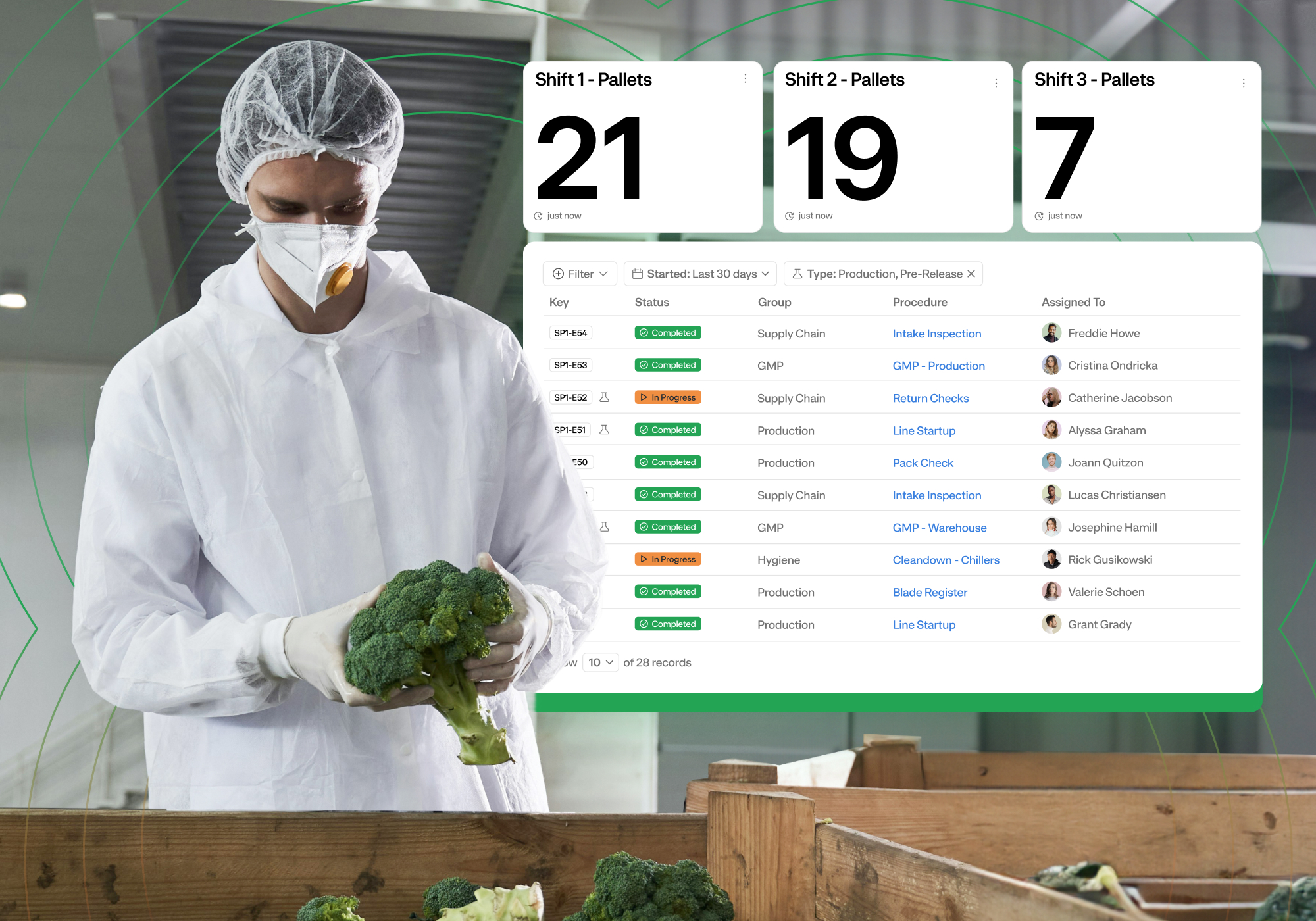

Start your digital transformation today
Join the many businesses driving efficiency and compliance with FoodOps. Arrange a demo today to experience the future of food manufacturing.
