
Replace traditional paper forms with digital workflows.

View your data in real-time, exactly how your teams want it.

Flexible factory applications, built around your operations.

FoodOps works seamlessly as part of your business.

Streamline non-conformance handling with custom workflows.

Automate your schedules and enjoy a live view of your operations.

Centralise your documentation and make it available effortlessly.

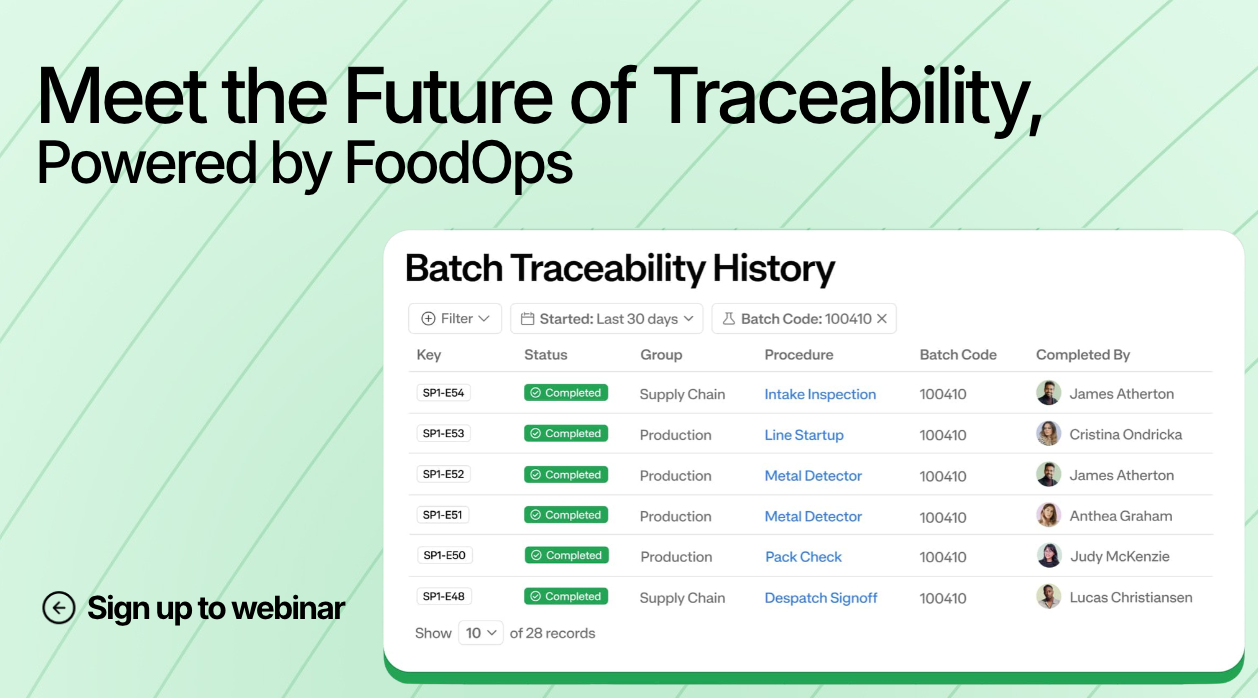
Automate traceability & mass balance from stock to despatch.

Unify teams from lairage to coldstore with connected digital workflows

Strengthen traceability, grading accuracy, and factory productivity with connected systems

Maximise yield, welfare compliance, and throughput with smarter workflows

Enhance efficiency and visibility across the entire operation, from field to packhouse

Transform your dairy operation with digital workflows and connected data

Empower teams with real-time data and digital workflows built to your exact SOPs

Build compliance into your processes by default and monitor with ease.

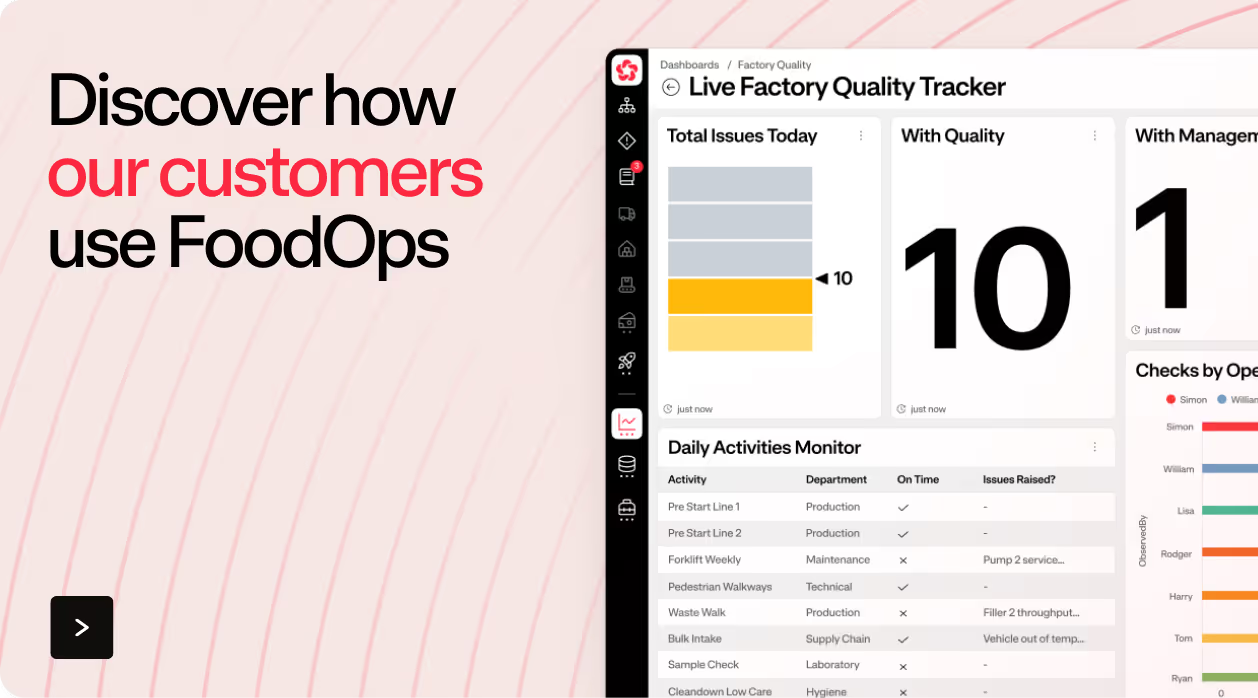
Empower your teams to make data-driven decisions.
Manage PPE, asset logs and follow-up actions all in one tool.

Get real insight into your supplier performance, in real time.

Set up and manage your hygiene processes all from one tool.

Streamline HSE with digital workflows for near misses and accidents.
How FoodOps Supports Every Team Across the Food Factory

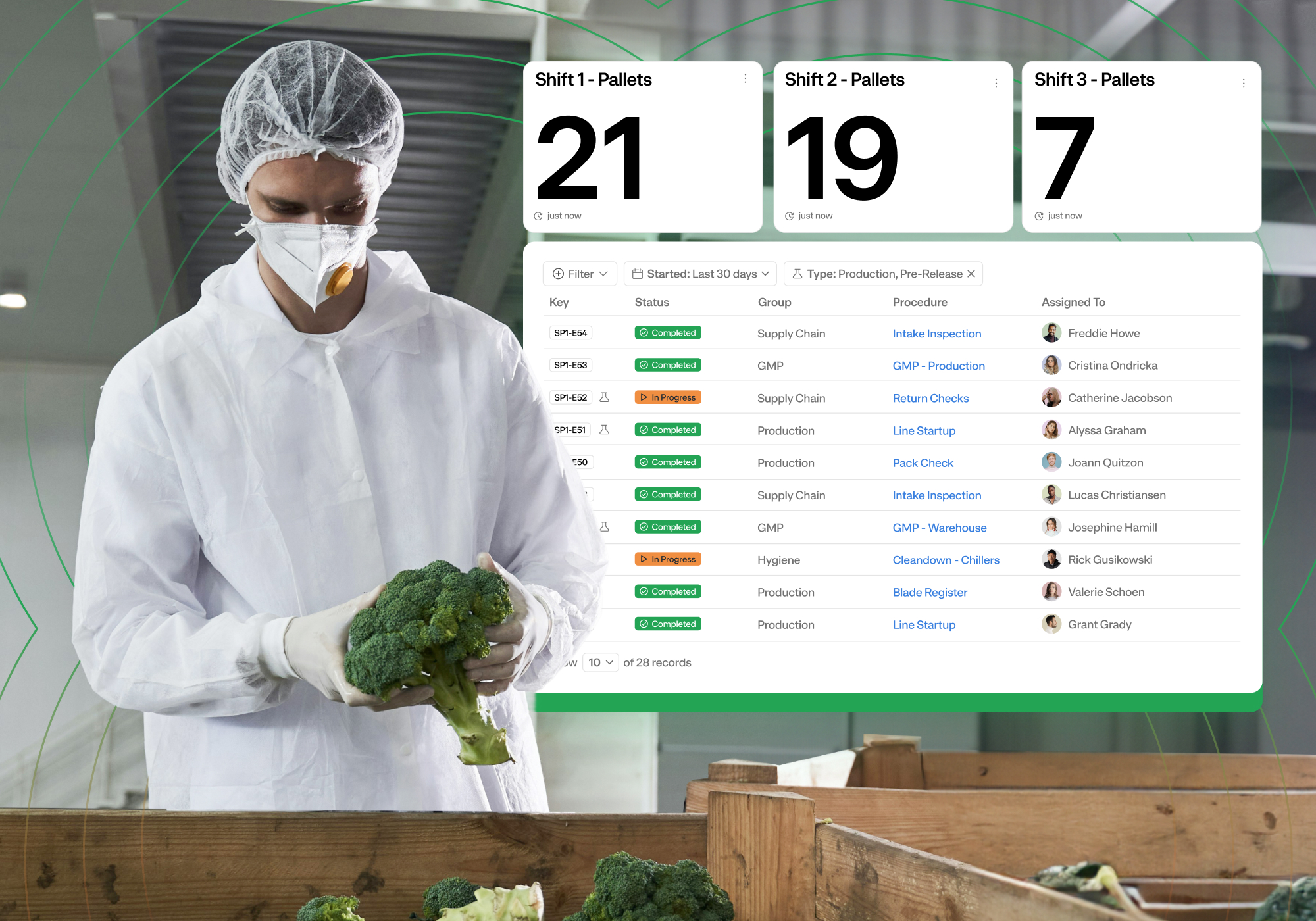
From production managers and factory operators to quality technicians, warehouse teams and engineers, every team plays an important role in keeping a food manufacturing operation running smoothly. They all rely on accurate information, efficient processes and the right tools to do their jobs effectively.
Yet, in many factories, different departments rely on separate systems and tools to manage their day-to-day activities. While these may work well for individual teams, they often operate in silos, making it difficult to get a complete picture of what's happening across the wider operation.
FoodOps is rethinking how software works on the factory floor. More than just a collection of individual tools, it's a connected factory operations platform designed to bring teams, processes and information together. By combining operational data, workflows, automation and communication in one place, FoodOps helps break down departmental silos and create a more connected way of working that is specific to food manufacturers.
So, whether you're managing production, maintaining equipment, monitoring quality or overseeing factory-wide performance, let's explore how FoodOps supports your team and connects your role to the wider operation.
Operations Directors and Managers
Keeping track of everything happening across a factory isn't easy. From production performance and inventory to equipment reliability and operational costs, you need a clear picture of how the business is performing to make informed decisions.
When information is spread across different systems, spreadsheets and departments, getting that complete picture can be challenging.
FoodOps brings operational information together, giving you greater visibility and control across production lines, departments and sites. This makes it easier to monitor performance, standardise processes and identify opportunities for improvement.
FoodOps allows operations directors to:
- Monitor live factory performance, efficiency and KPIs across multiple production lines and sites.
- Gain complete visibility of production output, material usage, stock levels and operational performance.
- Standardise operational processes and reduce manual administration through automation.
- Identify inefficiencies, discrepancies and opportunities to reduce waste.
- Improve communication and coordination between departments and shifts.
- Scale connected factory processes more consistently across multiple locations.
Production Managers and Supervisors
Keeping production running smoothly means balancing targets, resources, people and unexpected challenges throughout the day. You need to know what's happening across your production lines, understand where performance is falling short and respond quickly when issues arise.
FoodOps gives you greater visibility of production activities, helping you monitor performance, coordinate daily operations and identify opportunities to improve efficiency.
From tracking output and yield to managing shift activities, the platform helps bring the information you need into one place.
FoodOps enables production managers to:
- Monitor production performance and compare planned versus actual output.
- Track yield, giveaway and material consumption.
- Identify downtime, production losses and recurring inefficiencies.
- Monitor live production progress and coordinate shift activities.
- Receive automated alerts and notifications about operational issues.
- Understand material availability and coordinate production requirements.
- Raise maintenance requests and monitor repair progress.
- Automate production activities, calculations, validations and notifications.
Factory Operators
On the factory floor, systems need to be straightforward, accessible and easy to use. Capturing production information, completing checks and communicating issues should fit naturally into daily activities, without slowing you down with unnecessary paperwork.
FoodOps supports digital data capture directly on the factory floor, helping complete everyday tasks more efficiently while reducing reliance on paper-based, manual processes.
Whether you're recording production information or using connected equipment, the platform helps make everyday workflows simpler.
FoodOps enables factory operators to:
- Capture production information digitally, reducing manual paperwork.
- Record actual material consumption during production.
- Complete production activities and required validations.
- Use connected scales, scanners and printers as part of your everyday workflows.
- Report equipment faults and maintenance requirements.
- Communicate with supervisors and colleagues directly through factory-floor interfaces.
- Access relevant workflows through PIN-based interfaces.
Quality and Technical Teams
Maintaining product standards, ensuring compliance and having confidence in your manufacturing records are essential to effective quality management.
But managing quality checks, traceability, product specifications and compliance across disconnected processes can create unnecessary administration and make it harder to access the information you need.
FoodOps connects quality and technical processes with wider factory operations, making it easier to access relevant information, automate workflows and maintain consistency throughout production.
FoodOps enables quality and technical teams to:
- Access batch records, supplier information and production data.
- Manage quality checks and compliance-related workflows.
- Automate quality escalations, status changes and notifications.
- Communicate non-conformances and share quality updates.
- Access expiry dates and material traceability information.
- Define and manage recipes, formulations and product specifications.
- Manage product label formats and information.
- Improve labelling consistency and reduce the risk of errors.
Warehouse and Procurement Teams
Knowing what stock you have, where it's located and when materials need replenishing is essential to keeping production moving.
Without accurate inventory information, it can be difficult to ensure materials are available when needed, avoid unnecessary overstocking and maintain confidence in stock records.
FoodOps connects inventory processes with wider production activities, giving you better visibility of stock movements, material availability and consumption. This helps warehouse and procurement teams make more informed decisions and keep materials flowing throughout the factory.
FoodOps allows Warehouse and procurement teams to:
- Manage goods-in, stock locations, transfers, picking and despatch activities.
- Monitor material availability and stock levels.
- Record stock movements and material consumption.
- Maintain batch information, expiry dates and traceability records.
- Use replenishment triggers to support purchasing activities.
- Identify potential shortages, discrepancies and unnecessary overstocking.
- Understand ingredient and raw material requirements based on production plans.
- Improve stock accuracy and material utilisation.
Engineering and Maintenance Teams
Keeping equipment reliable and minimising production downtime are ongoing priorities for engineering and maintenance teams.
Between planning preventative maintenance, responding to equipment faults and coordinating repairs, having access to the right asset information and work orders is essential. Without clear visibility, it can be difficult to stay ahead of issues and manage workloads effectively.
FoodOps helps bring maintenance activities together, giving your team better visibility of assets, maintenance requirements and equipment performance. Automation also helps ensure important activities and notifications aren't missed.
FoodOps helps engineering and maintenance teams to:
- Plan preventative maintenance activities and manage workloads.
- Monitor asset performance and maintenance costs.
- Automate preventative maintenance triggers and work order creation.
- Access asset information, maintenance procedures and spare parts requirements.
- Track equipment downtime and recurring production stoppages.
- Receive maintenance notifications and equipment alerts.
- Manage maintenance requests and monitor repair progress.
- Monitor parts consumption and engineering expenditure.
IT and Systems Administrators
Behind every connected factory is the technology that keeps its systems, equipment and processes working together.
Managing multiple integrations, connected devices and business-specific processes can become complicated, particularly when relying on disconnected tools or bespoke development to connect different systems.
FoodOps provides a connected platform where integrations, hardware configurations and automation logic can be centrally managed. This helps simplify the technology behind your factory and makes it easier to introduce and maintain connected equipment.
FoodOps gives you the ability to:
- Configure and maintain business-specific automation logic.
- Centrally manage integrations and hardware configurations.
- Connect factory equipment, including scales, scanners and printers.
- Reduce reliance on disconnected integration tools and bespoke development.
- Support the onboarding of new equipment and additional factory locations.
- Maintain connected workflows across different departments and systems.
- Simplify the deployment and management of connected factory technology.
Planning Teams
Whether you're planning production schedules, calculating material requirements or managing resource availability, accurate production data is essential.
Understanding expected yields, material requirements and actual production helps you plan more effectively and make better use of available resources.
FoodOps brings together production plans, material requirements and actual production information, helping you understand what is needed, what can be produced and how closely production is meeting its targets.
FoodOps helps planning teams to:
- Calculate ingredient and material requirements for planned production.
- Model manufacturing processes and understand expected outputs and yields.
- Compare planned against actual production.
- Understand material allocation and by-products.
Finance & Commercial Teams
Whether you're monitoring material costs, managing production budgets or looking for ways to protect margins, understanding manufacturing performance is essential.
Knowing how much material goes into production, what comes out and where losses occur helps you understand the true cost of manufacturing.
FoodOps allows finance and commericial teams to:
- Understand accurate material allocation and production costs.
- Monitor material costs, giveaway and production efficiency.
- Compare theoretical and actual yields to identify material losses.
- Identify opportunities to reduce waste and protect margins.
Continuous Improvement Teams
Whether you're investigating material losses, improving production efficiency or looking to reduce recurring operational issues, understanding what's happening across your factory is essential.
Visibility of production performance, yield variations, equipment losses and stoppages helps you identify inefficiencies and understand where improvements can be made.
FoodOps brings together production data and operational performance information, helping you identify recurring issues, understand material losses and measure the impact of process improvements.
FoodOps helps continuous improvement teams:
- Analyse production performance and efficiency.
- Identify equipment losses and recurring stoppages.
- Investigate material losses and yield variations.
- Reduce waste, improve yields and optimise resource utilisation.
FoodOps: The Factory Operations Platform for Food Manufacturers.
Every team in your factory has different responsibilities, challenges and priorities. But their work doesn't happen in isolation.
Production relies on warehouse teams for materials, quality teams need access to production records for traceability, engineering supports equipment reliability, and management needs visibility across all these activities.
FoodOps brings these different functions together in one connected platform.
By combining production management, inventory, process modelling, maintenance, automation, connected equipment and communication, FoodOps gives you and your teams access to the tools and information needed to work more effectively.
It's not just about improving one process or supporting one department. It's about connecting the people, processes and information that keep your entire factory running.
FoodOps provides one connected platform for every team in your factory.
Register for our next webinar >


Start your digital transformation today
Join the many businesses driving efficiency and compliance with FoodOps. Arrange a demo today to experience the future of food manufacturing.
