
Replace traditional paper forms with digital workflows.

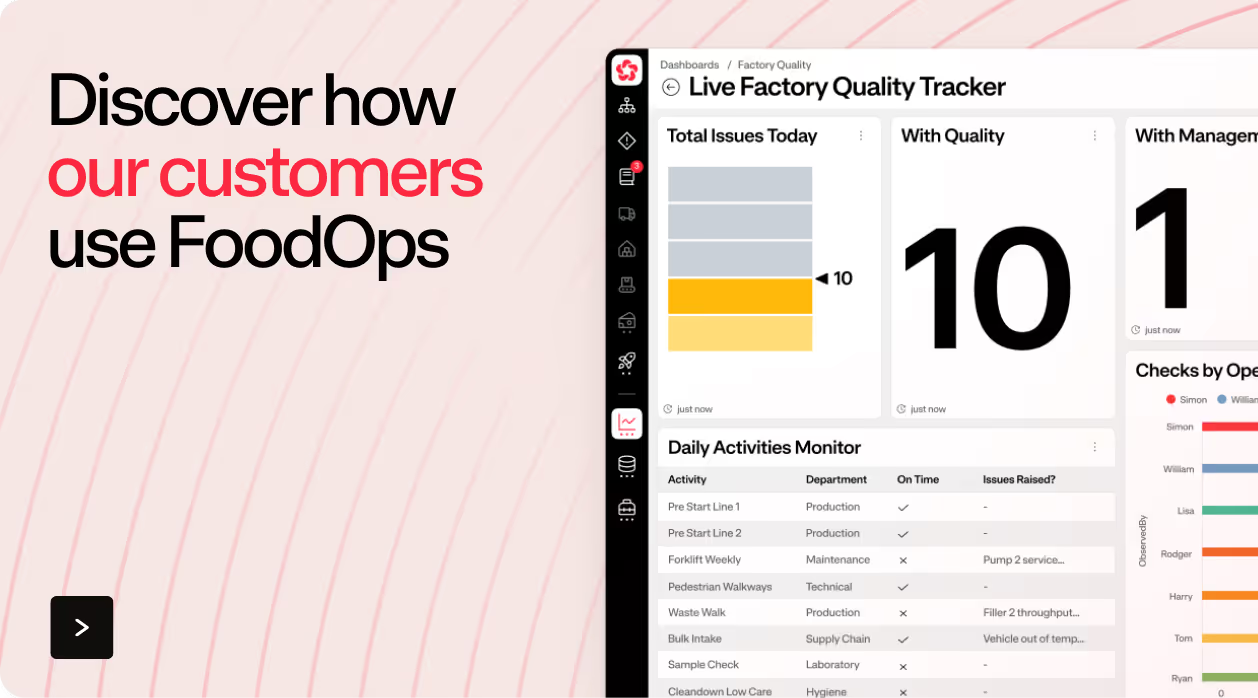
View your data in real-time, exactly how your teams want it.

Flexible factory applications, built around your operations.

FoodOps works seamlessly as part of your business.

Streamline non-conformance handling with custom workflows.

Automate your schedules and enjoy a live view of your operations.

Centralise your documentation and make it available effortlessly.

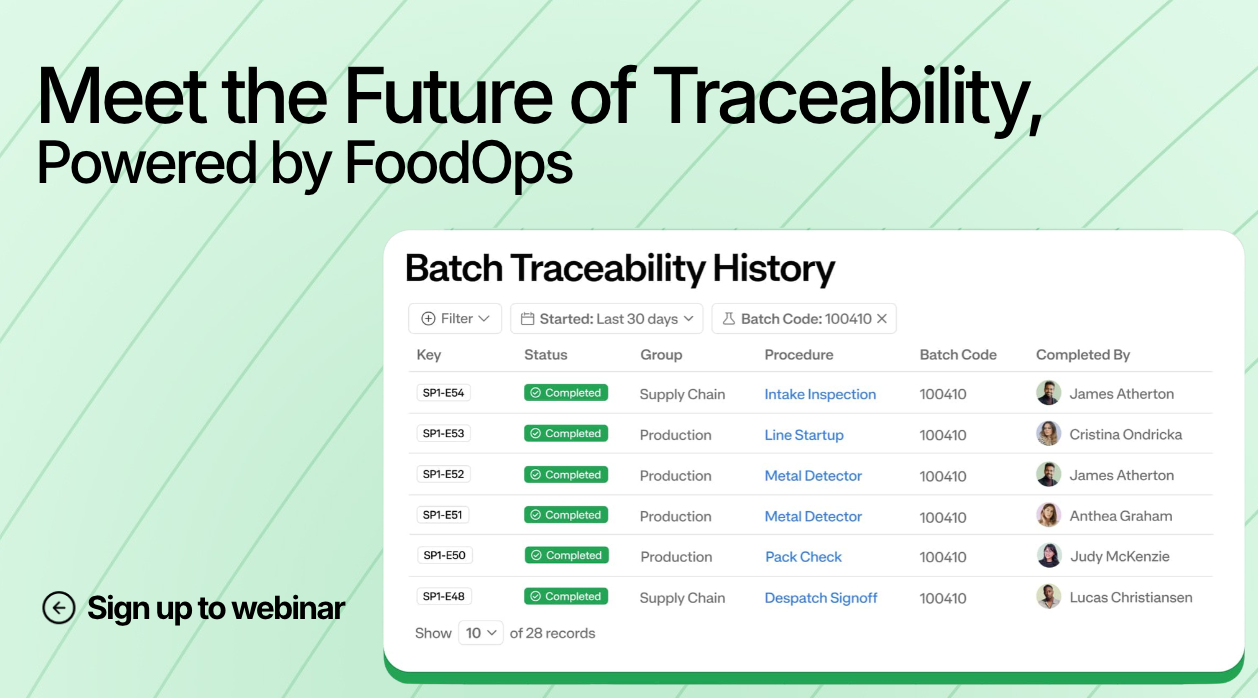
Automate traceability & mass balance from stock to despatch.

Unify teams from lairage to coldstore with connected digital workflows

Strengthen traceability, grading accuracy, and factory productivity with connected systems

Maximise yield, welfare compliance, and throughput with smarter workflows

Enhance efficiency and visibility across the entire operation, from field to packhouse

Transform your dairy operation with digital workflows and connected data

Empower teams with real-time data and digital workflows built to your exact SOPs

Build compliance into your processes by default and monitor with ease.

Empower your teams to make data-driven decisions.
Manage PPE, asset logs and follow-up actions all in one tool.

Get real insight into your supplier performance, in real time.

Set up and manage your hygiene processes all from one tool.

Streamline HSE with digital workflows for near misses and accidents.
The Impact of Automated Traceability in Food Manufacturing


For many food manufacturers, traceability across the factory floor still relies on paper records, spreadsheets, manual data entry and information spread across different systems.
This approach can work, but as production volumes increase, working environments change and customer requirements grow, paper and manual processes can significantly increase the risk of errors.
Traditional ERP and stock systems are capable of managing single-step batch traceability, but the reality of most food manufacturers is far more complex that these systems can manage without costly and complex bespoke reporting. Add into this the process checks and audits and the manual workarounds become extremely hard to manage.
Automated traceability captures information as part of the production process, creating a connected view of materials, ingredients, batches, process checks, stock movements and finished products.
In this guide, we've put together seven ways automated traceability can benefit the factory floor.
Seven Ways Automated Traceability Can Benefit Food Manufacturing
1. Reduce Risk When Something Goes Wrong
Traceability is most valuable when there is a problem.
Whether it's a raw material issue, quality deviation, allergen concern or food safety incident, teams need to quickly answer: What was affected? Where did it go? What else could be affected?
How automated traceability helps:
- End-to-end batch tracking from incoming materials to finished product
- Forward and backward traceability
- Complete records of ingredients, packaging and production activity
- Rapid identification of affected batches and stock
- Digital traceability tags for instant searching
The impact: Faster, more controlled responses
Teams can quickly identify what has been affected without searching through multiple records.
2. Reduce Admin for Production and QA Teams
Manually recording, transferring and checking traceability information creates unnecessary admin and increases opportunities for errors and missing data.
Automated traceability captures information as materials are received, scanned, consumed, transferred and added to batches.
How automated traceability helps:
- Automatic capture of batch and material movements
- Digital production and traceability records
- Automated mass balance calculations
- Reduced manual data entry and duplication
- Accurate information available in a few clicks
The impact: Less admin and better use of people's time
The right information is captured once, accurately, at the point of activity and is available when needed.
3. Improve Recall Readiness
The BRCGS currently requires recall readiness within 4 hours. Even though that's achievable when using paper, the time wasted and risk of error is driving more manufacturers towards automated traceability.
How automated traceability helps:
- Visibility of stock, transfers and product movements
- Forward and backward traceability
- Rapid identification of affected batches and products
- Traceability reports generated from production data
The impact: Faster, more targeted recall investigations
Teams can establish the potential scope of an incident quickly, helping reduce unnecessary product withdrawals and investigation time.
4. Always Audit Ready
Whether it's SALSA, BRCGS or a customer audit, preparing evidence can place a significant workload on QA teams.
How automated traceability helps:
- Real-time digital audit trails
- Electronic batch and production records
- Traceability and mass balance reporting
- Accessible records for customer, certification and regulatory audits
The impact: Audit evidence is ready when you need it
Instead of reconstructing records, reliable traceability evidence is captured as production takes place.
5. Strengthen Material Control and Mass Balance
Manual mass balance calculations can make discrepancies difficult to identify and investigate. Whereas automated mass balance provides a continuous view of material consumption against production output.
How automated traceability helps:
- Automated mass balance calculations
- Batch-level material consumption
- Comparison of planned and actual usage
- Identification of discrepancies, waste and production losses
- Improved reconciliation between physical stock and system records
The impact: Better yield, less waste and greater stock accuracy
Operationals teams can identify variances earlier and gain a clearer picture of how efficiently materials are being used.
6. Standardise Traceability Across the Factory
Consistent traceability becomes harder to maintain when different teams, lines or sites record information in different ways. Automated traceability builds the required controls directly into factory workflows, ensuring traceability is a by-product of production, not an additional task.
How automated traceability helps:
- Standardised traceability workflows
- Barcode and mobile scanning
- Accurate data capture at the point of production
- Consistent batch and material recording
- Integration with ERP, MES, inventory and quality systems for complete visibility
The impact: Consistent processes and better-quality data
Operators are guided through the required steps, reducing the opportunity for missing or incorrectly recorded information.
7. Scale Traceability as the Business Grows
More products, ingredients, production lines and sites mean more information to control. If traceability remains manual, the administrative burden grows with the operation, making consistency harder to maintain.
How automated traceability helps:
- Traceability embedded into standard workflows
- Repeatable processes for new products and production lines
- Accurate and real-time data capture
- Connected information across production, warehouse, quality and inventory
- Consistent controls as operations expand
The impact: Scale without increasing the risk and output
When traceability is built into the process, new products, lines and production areas ensure traceability from day one.
The Bigger Impact of Automated Traceability
The value of automated traceability isn't simply having a digital version of a paper-based record. It's about capturing reliable information as manufacturing happens and connecting it across the operation.
Materials are received. Ingredients are consumed. Batches are produced. Products are packed. Stock is moved. When those activities are connected, teams have a clear view of what happened, when it happened, what materials were involved and what products were affected.
This supports:
- Faster investigations
- More effective recalls
- Better material control
- Accurate mass balance
- Fewer manual processes
- Easier audits
- Improved yield and waste visibility
- More consistent processes
- Scalable production
Integrating Traceability Into Factory Operations
The biggest shift manufacturers find can be moving from traceability as a separate manual task to traceability as part of the manufacturing process.
When information is captured automatically as work happens, there is no need to have traceabilty as a separate tasks. Traceability then becomes part of the operational infrastructure of the factory to support better control, faster decisions and continuous improvement across the shop floor.
How FoodOps Automates & Integrates Traceability
FoodOps is the factory operations platform built for the food industry, it allows teams to drive full compliance from goods in to goods out in real-time, across the whole production cycle.
- Automated, end-to-end traceability from stock to despatch
- Accurately calculate mass balance and yield througout the whole production process
- Build traceability into workflows across the factory floor
- Capture information in real time
- Retrieve audit evidence in minutes
- Respond to recalls in seconds
- Connect workflows across departments
- Standardise processes across teams and sites
FoodOps is designed around the factory floor, not the other way around.
Ready to see FoodOps in action?
We’ll show you how your existing traceability processes can be digitised and connected in a real factory environment.
Book a demo and see what automated traceability looks like >
Join our Traceability & Mass Balance Webinar >

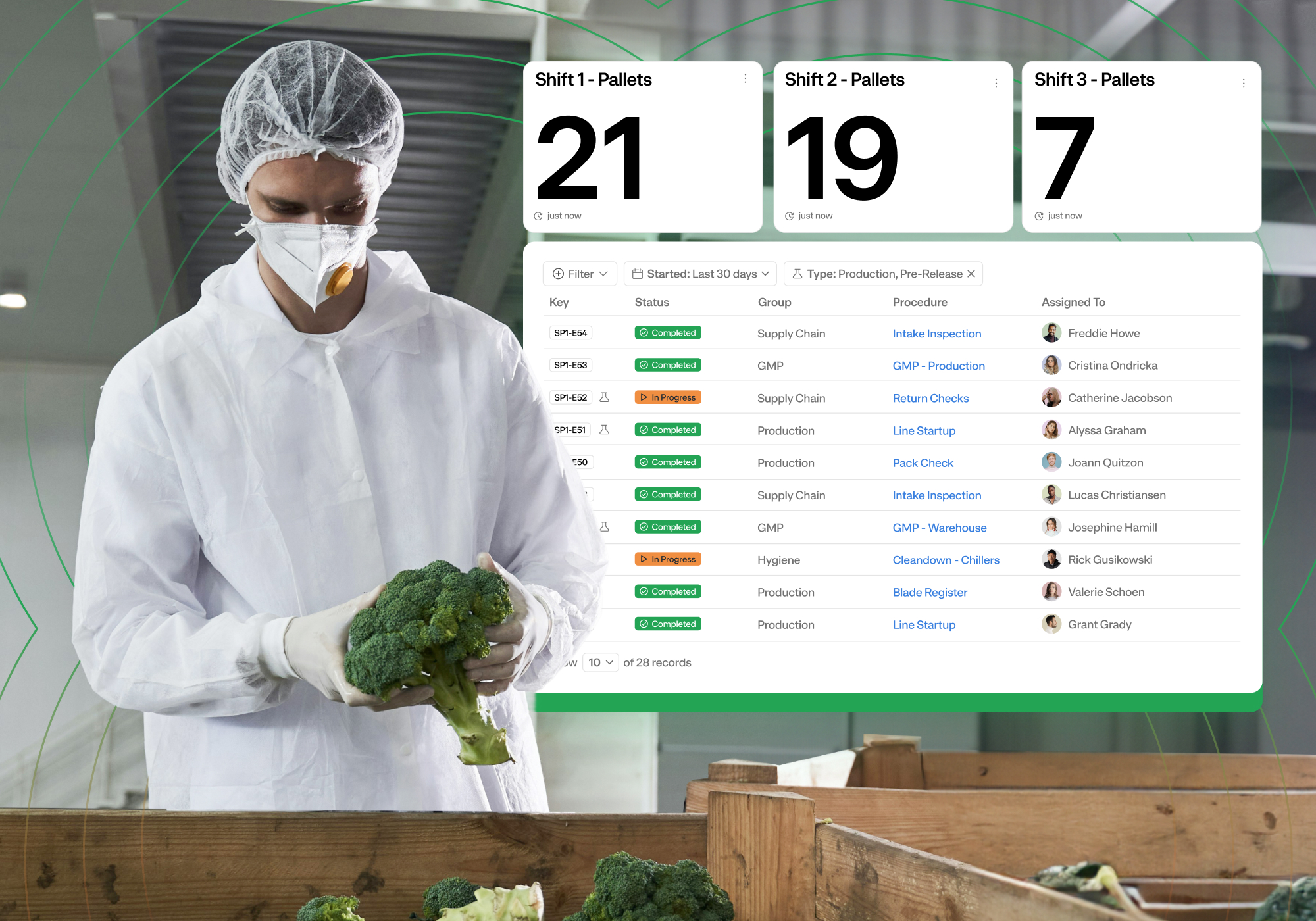

Start your digital transformation today
Join the many businesses driving efficiency and compliance with FoodOps. Arrange a demo today to experience the future of food manufacturing.
